

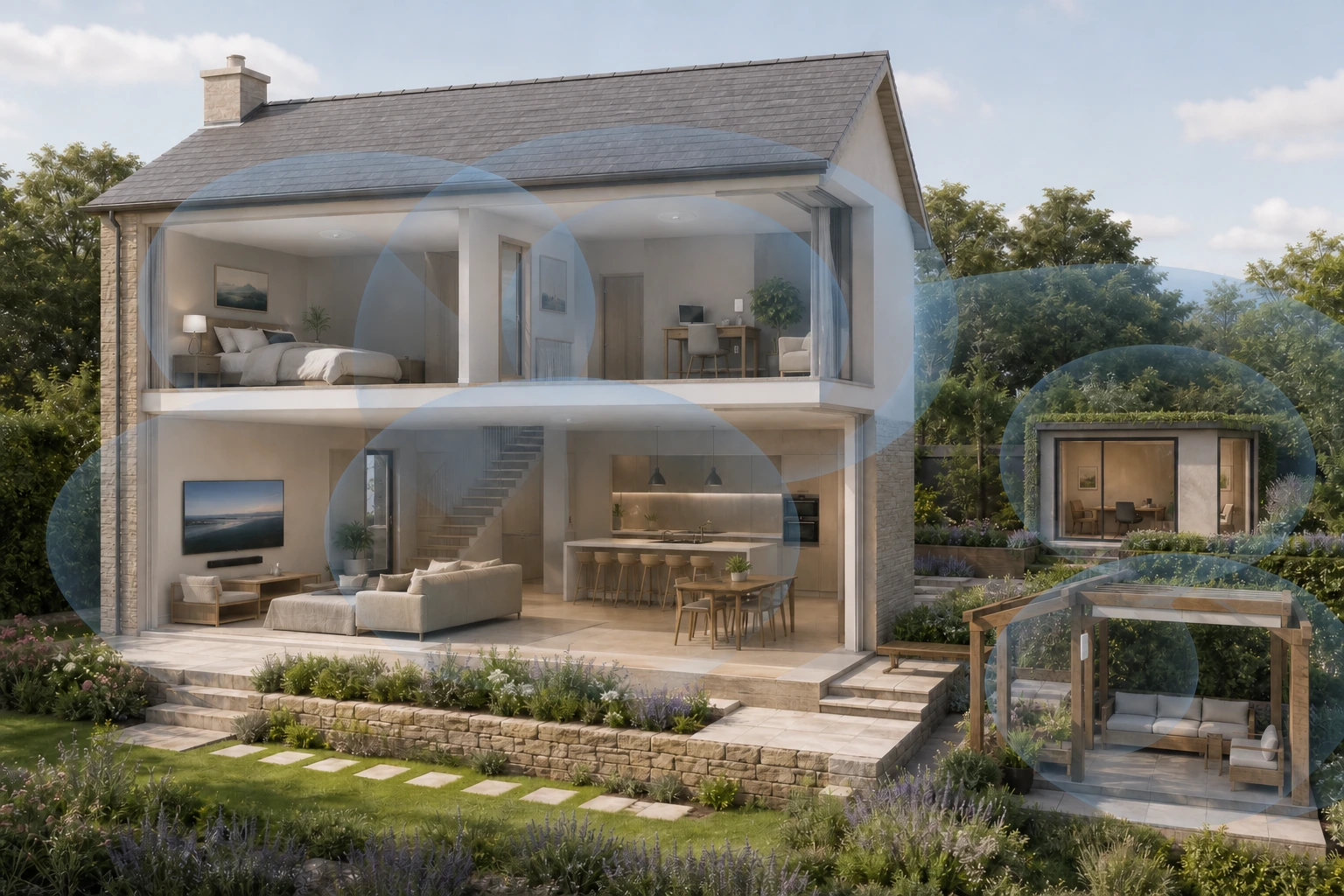
A speed test beside the router can look excellent while calls drop upstairs, television buffers in another room and the garden has no useful connection. That is a network-design problem—not something every property simply has to tolerate.
Broadband and Wi-Fi are different
Broadband is the connection arriving at the property. Wi-Fi is one way your own network distributes that connection. Thick walls, foil-backed insulation, underfloor heating, mirrors, distance and interference can all weaken wireless coverage even when the incoming service is fast.
Coverage should be planned around use
Good design starts with where people actually need connectivity: bedrooms, working areas, televisions, cameras, control systems, terraces and gardens. Access points are then positioned to create useful, overlapping coverage rather than one very powerful signal in the wrong place.
- Ceiling access points for broad room coverage
- In-wall access points where local connections are useful
- Outdoor models for terraces and gardens
- Separate consideration for fixed equipment and mobile devices
Speed is only one measurement
Consistency, latency, roaming and capacity matter too. A dependable network should keep a video call stable, move a phone between access points sensibly and support many connected devices without one busy area affecting the rest of the property.
The network should remain understandable
Professional does not need to mean intimidating. A correctly sized cabinet, labelled cabling, documented equipment and remote support can keep the system neat and serviceable without installing commercial-scale hardware where it is not needed.